

An egg wholesaler who changed California housing
In 1943, a man named Joseph Eichler moved his family into a rental house in Hillsborough. He was in the egg and butter business at the time. The house happened to be the Bazett House, a Usonian home designed by Frank Lloyd Wright. He lived there for about two years. Within six years he had left the food business entirely and founded Eichler Homes. This is worth stating clearly, because it is often garbled: Eichler was a developer, not an architect. The homes were designed by three firms: Anshen & Allen, Jones & Emmons, and Claude Oakland & Associates. And his design lineage traces to Frank Lloyd Wright, not to the Bauhaus.
What made Eichler historically significant was not that he invented a style. It was that he took modernist architecture, until then something only wealthy clients could commission, and mass-produced it for middle-class buyers. Between 1949 and 1974 his company built more than 11,000 homes across California.
There is one more thing worth knowing about him. Eichler sold to buyers of any race and religion at a time when that was far from standard practice. He sold to Asian American families beginning around 1950 and to a Black family in Palo Alto in 1954. In 1958 he resigned from the National Association of Home Builders when the organization refused to support a non-discrimination policy. Buying an Eichler means buying into that history too.
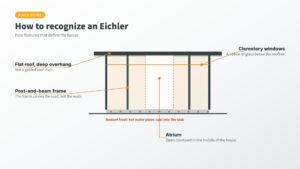
How to recognize one
The case for buying one
Light and spatial quality that cannot be reproduced. Floor-to-ceiling glass combined with an atrium dissolves the boundary between inside and outside. Between modern building codes, energy requirements, and land costs, it is effectively impossible to build this way today at any reasonable price.
An open plan sixty years ahead of its time. What developers now market as “open concept” was standard in an Eichler in 1959. Because the post-and-beam structure carries the load, reconfiguring the interior is far more feasible than in a conventional stick-framed tract house.
Officially recognized historic value. The Fairglen Additions in San Jose’s Willow Glen, 218 homes built between 1959 and 1961, were listed on the National Register of Historic Places on June 6, 2019.
A community that shares a design sensibility. Eichler owners tend to care about the architecture. Streetscapes stay visually coherent in a way that most postwar tracts, remodeled piecemeal over seventy years, simply do not.
The case for caution
This is the part that gets glossed over in listing copy. Every one of these is a real, recurring cost.
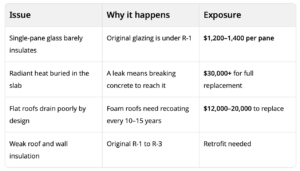
A few notes on these. The glass is the trade-off at the heart of the house. The thing that makes an Eichler extraordinary to live in is the same thing that makes it expensive to heat. Retrofitting to dual-pane is possible, but on a house with this much glazing the cost adds up quickly. The radiant heating deserves particular attention during inspection. The original systems are now sixty to seventy years old. When one fails, you are not repairing a furnace. You are potentially demolishing and repouring flooring. Many owners have abandoned the original system and installed forced-air or mini-splits instead, which is worth asking about on any property you tour. None of this makes an Eichler a bad purchase. It makes it a purchase that requires an accurate maintenance budget. A buyer who understands these numbers going in is far happier than one who discovers them in year two.
Before you buy: three things to check
This is the part most buyers miss entirely, and it can determine whether you are allowed to make the changes you are planning.
1. Single-Story Overlay (SSO)
Some Eichler blocks carry zoning that prohibits second-story additions. This cuts both ways: your neighbor cannot build up and block the light your house was designed around, but neither can you.
Palo Alto and Sunnyvale have implemented this on specific blocks. In Palo Alto the boundaries are defined down to individual street addresses. If your plan involves adding square footage upward, this is the first thing to confirm.
2. Eichler Objective Design Standards (ODS)
San Jose has taken a different approach. Rather than a citywide Eichler overlay, it developed Objective Design Standards governing exterior alterations. These currently apply to properties in the Fairglen Additions historic district, where changes requiring a Single-Family House Permit go through historic review.
One caveat worth flagging: the City Council was scheduled to take final action on the ODS in December 2025. I have not been able to independently confirm the current adopted status, so please treat this as something to verify rather than as settled fact.
3. Whether this specific address is covered
Overlays and design standards frequently apply to only part of a tract. Two houses on the same street can fall under different rules. Check the address, not the neighborhood name.
Verify with the city directly: San Jose Planning, Building & Code Enforcement: (408) 535-3555
The bottom line
An Eichler is a genuine piece of California architectural history, and the experience of living in one is difficult to replicate at any price. The light, the atrium, the way the house opens to the outside: none of that shows up in a spec sheet, and none of it can be built new today.
But it rewards buyers who go in with clear eyes. Budget honestly for the glass, the slab, and the roof. Confirm the zoning before you count on any renovation plan. Get an inspector who has seen these houses before.
If you are considering an Eichler in the South Bay, I am happy to walk a property with you and talk through what it will actually cost to own.
Sources:
- Joseph Eichler biography, Bazett House tenancy, and non-discrimination record. Eichler Network; National Trust for Historic Preservation; Dwell; Houzz
- Fairglen Additions: 218 homes, 1959–1961, National Register listing June 6, 2019; architects Anshen & Allen, Jones & Emmons, Claude Oakland. Wikipedia (Fairglen Additions, NRHP entry)
- Production totals 1949 to 1974. Wikipedia (Joseph Eichler)
- Maintenance cost ranges. Multiple independent Bay Area contractor and Eichler-specialist sources (glazing, radiant heat replacement, foam roofing)
- Single-Story Overlay implementations in Palo Alto and Sunnyvale. Planetizen; City of Palo Alto staff reports
San José Eichler Neighborhood Objective Design Standards. City of San José Planning Division


