
FinCEN’s New Cash Buyer Rule: What You Need to Know

Starting March 1, 2026, if you buy residential real estate with cash using an LLC, trust, or corporation, your personal information must be reported to the federal government. This is the new permanent reality for cash transactions through entities.

Does This Affect You?

The rule applies when ALL THREE conditions are true:

1. Property Type: Single-family homes, condos, townhouses, or 2-4 unit properties

2. Payment Method: All cash, hard money loans, private financing, or cryptocurrency

3. Buyer Identity: LLC, corporation, partnership, or any type of trust

* Quick Test: Buying a $3 million Los Gatos home with cash through your family LLC = YES, the rule applies.

Buying the same home with a mortgage = NO, you’re exempt.

What Must You Disclose?

You must identify every person who owns 25% or more of the entity or controls major decisions.

For each person, you must provide:

– Full legal name

– Date of birth

– Home address (no P.O. boxes)

– Social Security Number

– Driver’s license or passport number

– Citizenship status

– Ownership percentage

*Complex Example: You own 100% of “Smith Holdings LLC,” which owns 100% of “Property Investment LLC” that buys the house. You must disclose yourself as the beneficial owner, even though the house is purchased by the second LLC.

Who Files the Report?

The title company or escrow officer files the report within 30 days of closing. You don’t file it yourself. Your job is simply to provide accurate information when requested.

Penalties Are Serious:

– Civil Penalties: Up to $1,394 per day for late filing. A 30-day delay could cost you over $40,000.

– Criminal Penalties:** Up to $250,000 fine and 5 years in prison for willful violations. This includes intentionally hiding information or structuring transactions to avoid reporting.

*Important: There are no warnings. First-time violations carry full penalties.

What This Means for Your Timeline

Before: 30 days to close a typical transaction

Now: 35-45 days to close

– 5-10 extra days for basic documentation

– 10-15 days for international owners

– 15-20 days for complex multi-entity structures

*Pro Tip: Start gathering documents before making offers. In competitive markets like Palo Alto or Los Gatos, these delays can kill deals.

Your Options

Option 1: Individual Purchase**

Buy in your own name. No reporting required, but you lose all entity benefits.

Option 2: Traditional Financing**

Use a bank mortgage instead of cash. This exempts you from reporting while maintaining some entity benefits.

Option 3: Accept the Reporting**

Keep your LLC or trust and comply with the new requirements. You keep asset protection and tax benefits, but the government knows who you are.

Documents to Prepare

Gather these before you start shopping:

– Government-issued ID for all beneficial owners

– Proof of home address (utility bills or bank statements)

– Entity formation documents

– Organizational charts showing ownership percentages

– Board resolutions authorizing the purchase

Common Questions

Q: Does this apply to my family living trust?**

A: Yes. Even revocable trusts used for estate planning must report if buying with cash.

Q: What if I put 50% down and get a bank loan for 50%?**

A: If you have a traditional bank mortgage, you’re likely exempt regardless of the down payment amount.

Q: Can I avoid this by buying as an individual, then transferring to my LLC later?

A: Technically possible, but this creates tax consequences and title complications. Consult your attorney first.

My Recommendations

For Privacy-Focused Buyers:** Consider using traditional financing instead of cash, or accept that privacy through entities is no longer possible.

For Entity Buyers:** The benefits of LLCs and trusts still outweigh the compliance burden for most situations. Plan accordingly.

For All Buyers:** Factor extra time into your transaction planning. In competitive markets, documentation delays can cost you the property.

For International Buyers:** Expect longer timelines (10-15 extra days) for verification of foreign documents and identities.

Next Steps

1. Review your current entity structure with your attorney

2. Decide whether to keep entities or adjust your strategy

3. Prepare documentation packages for future purchases

4. Build extra time into transaction timelines

5. Work with title companies experienced in FinCEN compliance

Why This Matters

This rule is permanent, nationwide, and actively enforced. FinCEN has shown consistent enforcement across other industries, and penalties are severe from the first violation.

The real estate industry is adapting with new technology and processes. Title companies are building compliance systems, and experienced agents are factoring these requirements into transaction planning.

Bottom Line: Plan ahead, comply properly, and don’t let documentation delays derail your purchase.

———

*This article is for informational purposes only and does not constitute legal or tax advice. Consult qualified legal and tax professionals regarding your specific situation.*

Prop 19 Explained: What Every California Homeowner Should Know Before Selling or Transferring Property

Passed by California voters in November 2020 and implemented in 2021, Proposition 19 is a constitutional amendment that drastically changed the landscape of property taxes in the state. It reshaped the rules in two major ways: by tightening inheritance tax benefits for children and expanding tax transfer rights for eligible homeowners.

Here is a breakdown of how Prop 19 affects California homeowners and heirs.

  • The replacement property can be more expensive than the original property; if so, the new property’s assessed value is adjusted upward to reflect the difference in value.
  • The base year value transfer rules are more flexible, allowing moves to expensive homes and to any county in the state.

Impact on Inherited Property

  • The old rule (Prop 58) allowed parents to pass a low tax base to children for both their primary residence and up to $1 million of other property.
  • Prop 19 now only lets inherited homes keep the low tax base if the heir makes the home their principal residence—otherwise, the property is reassessed at market value.
  • All other inherited property (such as vacation and rental properties) now faces reassessment upon transfer.

1. Inheriting a Parent’s Home: Stricter Rules

Historically, children could inherit their parents’ home (and even rental properties) while keeping the parents’ original, low Proposition 13 property tax base. Prop 19 eliminated this broad protection.

Today, children can only retain the parent’s low property tax base if they meet strict criteria:

  • Primary Residence Requirement: The heir must move into the home and establish it as their primary residence within 1 year of the transfer/inheritance.
  • No Protection for Second Homes: If the inherited home is rented out, left vacant, or used as a vacation property, it will be reassessed at its current fair market value, usually resulting in a significantly higher property tax bill.

 * The $1 Million Cap Rule *

Even if the heir successfully moves into the home, the tax protection is not unlimited. Prop 19 caps the amount of value that can be excluded from reassessment.

Formula: The new taxable value is (Parent’s Assessed Value + $1,000,000).

  • If Market Value ≤ (Assessed Value + $1,000,000): The low tax base is retained.
  • If Market Value > (Assessed Value + $1,000,000): A partial reassessment occurs. The new taxable value = Market Value − $1,000,000.

2. Tax Base Transfers: Expanded Rights for Eligible Homeowners

While Prop 19 restricted inheritance rules, it created massive benefits for older and vulnerable homeowners. Those who are age 55+, severely disabled, or victims of a wildfire/natural disaster can now transfer their current property tax base to a replacement home with unprecedented flexibility.

  • Sell your current primary residence (the one with the low assessed value)
  • Anywhere in the State: You can move to any county in California
  • Buy or build a new primary residence within 2 years of the sale
  • File a claim with the county assessor (Form BOE-19-B) — must be filed within 3 years of the new home purchase
  • Anywhere in California (no longer limited to same county or 10 reciprocal counties like old Prop 60/90)
  • Up to 3 Times: Eligible homeowners can use this benefit up to three times in their lifetime. (Victims of natural disasters have no lifetime limit)


 * Website:  County of Santa Clara Property Tax Lookup

3. How Prop 19 Works in Practice: 5 Common Scenarios

Example 1: Primary Residence Inheritance (No Reassessment)

Mary inherits her late mother’s home in San Jose.

  • Assessed Value: $200,000 | Market Value: $1,500,000
  • Outcome: Mary moves in and files a Homeowner’s Exemption within 1 year. Because the market value does not exceed the cap ($200k + $1M = $1.2M excluded, but wait—actually $1.5M > $1.2M, so she would face a partial reassessment. Let’s adjust the example to fit the “No Reassessment” math: Market Value is $1,100,000).
  • Corrected Outcome: Mary moves in within 1 year. Because the market value ($1.1M) is less than the $1.2M cap, she retains the $200,000 tax base entirely.


Example 2: Heir Does Not Move In (Full Reassessment)

John inherits a Los Angeles rental property from his father.

  • Assessed Value: $300,000 | Market Value: $1,200,000
  • Outcome: John already owns a home and decides to keep his father’s property as a rental. Because it is not his primary residence, the property is immediately re-assessed to $1,200,000. His annual property taxes skyrocket.


Example 3: Vacation Home Inheritance

Lisa and David inherit a family cabin in Lake Tahoe.

  • Assessed Value: $150,000 | Market Value: $900,000
  • Outcome: Prop 19 offers zero automatic protection for vacation homes. Only one sibling could qualify for the tax break, and only if they made the cabin their primary, year-round residence. If neither moves in, the tax base resets to $900,000.


Example 4: Moving Out After Inheriting

Emily inherits her mother’s San Diego home, moves in, and successfully keeps the low tax base for two years. Later, she buys a new house and converts the inherited home into a rental.

  • Outcome: The Prop 19 exclusion requires continuous residency. When Emily moves out, the property is reassessed at the current market value as of her move-out date. The inherited low tax base is lost forever.


Example 5: Multiple Children as Heirs

Three siblings jointly inherit a Los Gatos home. Only Mark plans to move in.

  • Outcome: Mark does not need to be the sole owner to qualify. As a co-owner, he can apply the exclusion to his 1/3 share (keeping the parents’ low tax base for his portion). However, his siblings’ 2/3 share will be reassessed at current market value, resulting in a blended, partial reassessment for the property.


⚠️ Important Warning: Sibling Buyouts and Prop 19

Following up on Example 5, what happens if Mark wants to buy out his two siblings so he can own the house outright?

The Trap: Sibling-to-sibling property transfers are not protected by Prop 19. If Mark simply buys his siblings’ 2/3 share, that transaction triggers a full market-value reassessment on that 2/3 portion of the house.

The Solution — Non-Pro-Rata Distribution: To avoid this nasty tax surprise, the estate must be planned carefully before assets are distributed. Using a “non-pro-rata distribution,” the trust or estate can allocate the house entirely to Mark, while using other assets of equal value (like cash, stocks, or life insurance proceeds) to compensate the other siblings. When structured correctly by an estate attorney, Mark inherits the house directly from the parent, avoiding a sibling-to-sibling transfer entirely.

These examples illustrate how Proposition 19 significantly narrows who can inherit a low property tax base. Properties kept for rental, vacation, or investment use now face immediate reassessment. Proper estate planning is essential to avoid unexpected tax increases.

For informational purposes only. Consult a qualified tax professional, attorney, or county assessor’s office for advice specific to your situation.


Understanding California’s Balcony Inspection Laws: SB 326 and SB 721

Why These Laws Exist

In 2015, a tragic balcony collapse in Berkeley claimed six lives and exposed serious gaps in the maintenance and inspection of wood-framed exterior structures. In response, California passed two laws — Senate Bill 326 (SB 326) and Senate Bill 721 (SB 721) — to prevent similar incidents and ensure the long-term safety of decks, balconies, and walkways in multifamily buildings.

Both laws focus on inspecting Exterior Elevated Elements (EEEs) — structures more than six feet above ground that rely on wood or wood-based materials for structural support.

Exterior Elevated Elements include:

  • Balconies
  • Decks
  • Porches
  • Stairways
  • Walkways
  • Railings


SB 326 applies to condominiums and other common interest developments governed by homeowners associations (HOAs). It requires that all elevated structures more than six feet above the ground, supported by wood or wood-based materials, undergo their first inspection by January 1, 2025, and every 9 years thereafter. The inspection must be conducted by a licensed structural engineer or architect, and the resulting report must be submitted to the HOA board and included in the association’s reserve study. This law ensures that associations proactively identify and address potential structural issues before they pose safety risks to residents.

SB 721 on the other hand, applies to multifamily rental buildings with three or more dwelling units. Property owners must also complete their first inspection by January 1, 2025, but subsequent inspections are required every 6 years. The inspection can be performed by a licensed architect, engineer, qualified building contractor, or certified building inspector. The report must be provided to the building owner and retained for at least two inspection cycles. If any unsafe conditions are found, repairs must be completed within a specified timeframe to maintain compliance and ensure tenant safety.

1031 Exchange Explained

A 1031 Exchange is a tax-deferral strategy for real estate investors, allowing them to sell an investment property and reinvest the proceeds into another “like-kind” property—thereby deferring the capital gains taxes that would otherwise be owed after the sale. It is named after Section 1031 of the IRS code and is sometimes called a “like-kind exchange.”

What is a 1031 Exchange?

A 1031 Exchange, named after Section 1031 of the Internal Revenue Code, permits investors to sell a qualified investment or business property and defer paying capital gains taxes, provided the proceeds are used to purchase a similar (“like-kind”) property of equal or greater value. This tax strategy is intended to encourage ongoing investment and applies only to real estate held for productive use in business, trade, or investment—not personal residences or property held primarily for resale.

How it Works

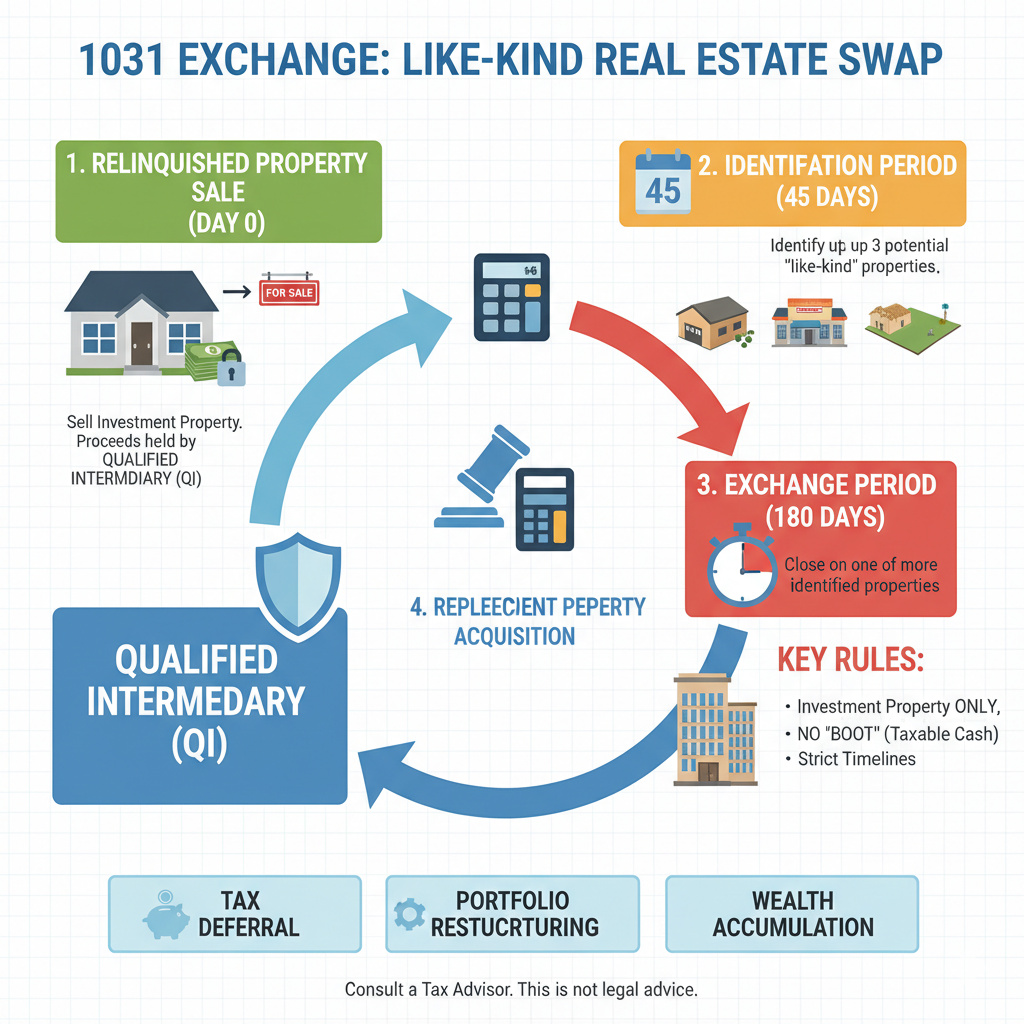
  1. Relinquished Property Sale: You sell an investment property (the “relinquished property”). The proceeds from this sale are held by a qualified intermediary (QI), not directly by you.
  2. Identification Period: Within 45 calendar days of selling the relinquished property, you must identify potential replacement properties. There are rules regarding how many properties you can identify:
    • 3-Property Rule: Identify up to three properties of any value.
    • 200% Rule: Identify any number of properties, as long as their aggregate fair market value does not exceed 200% of the fair market value of the relinquished property
  3. Exchange Period: Within 180 calendar days of selling the relinquished property (or the due date of your tax return for the year in which the relinquished property was sold, whichever is earlier), you must close on one or more of the identified replacement properties.
  4. Qualified Intermediary (QI): A QI is a crucial, independent third party who facilitates the exchange. They hold the sale proceeds from the relinquished property and use them to purchase the replacement property, ensuring you never have “constructive receipt” of the funds, which would trigger a taxable event.

Timeline Overview

Day o: Sale of the relinquished property closes; this starts the exchange clock.

Days 1–45: Identification Period. You must identify (in writing) up to three “like-kind” replacement properties you intend to acquire. If using the 200% rule, you may identify more, provided the total value doesn’t exceed 200% of the sold property.

Days 46–180: Exchange Period. You must purchase at least one of your identified properties and complete the transaction. The entire exchange must close within 180 calendar days of selling the relinquished property – no extensions unless under IRS disaster relief rules.

End of Exchange: Report the completed transaction to the IRS (Form 8824) and, for California, file Form FTB 3840 in the year of the exchange and annually until you pay tax on the deferred gain or meet an exception.

Types of Qualifying Properties

Virtually any business or investment real estate can qualify, including: Single-family homes, multifamily apartment buildings, commercial buildings, retail centers, industrial warehouses, farmland, leaseholds over 30 years, and more.

Key Benefits

• Tax Deferral: The primary benefit is the deferral of capital gains taxes. This allows you to reinvest the full value of your investment, potentially accelerating wealth accumulation.
• Estate Planning: Capital gains can be deferred indefinitely through successive exchanges, and upon your death, your heirs receive a “stepped-up basis,” potentially eliminating the deferred capital gains tax altogether.
Portfolio Restructuring: It allows investors to shift investments, for example, from one type of real estate to another (e.g., from a residential rental to a commercial property), or to consolidate multiple properties into one, or vice-versa.
• Location Changes: You can exchange properties in one geographical area for properties in another.

Conclusion

In conclusion, a 1031 Exchange is a powerful tax-deferral strategy that allows California real estate investors to preserve and grow their equity, but its success relies on precise timing, proper structuring, and strict compliance with IRS and California regulations. Working closely with a qualified intermediary, tax advisor, and real estate professional ensures that investors maximize the benefits while minimizing potential risks or costly mistakes.

California Electrification Mandate and What You Should Know

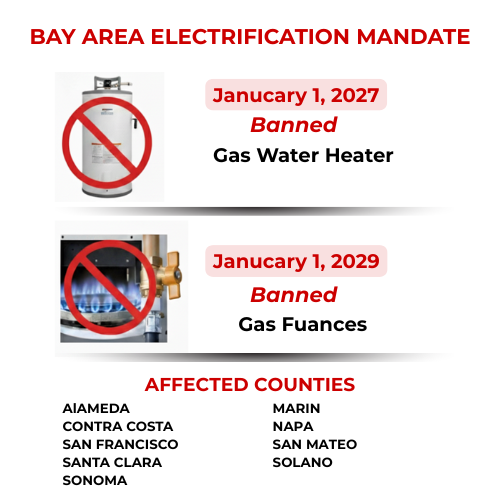
California is moving aggressively toward electrification, phasing out natural gas appliances – including water heaters—in both new and existing buildings. Here’s what you need to know about this transition:

Statewide Gas Appliance
Phase-Out and Electrification

  • Starting in 2030, California will ban the sale of new natural gas-fueled space and water heating appliances statewide.
  • In some regions (notably the Bay Area), the phase-out of new gas water heaters begins as early as 2027, and new gas furnaces will be prohibited starting in 2029.
  • For new construction, the 2025 Energy Code (effective Jan 1, 2026) requires heat pumps for most space and water heating in homes and some commercial
    buildings.

Why Electrification?

  • The switch is part of California’s efforts to reduce greenhouse gas emissions
    and improve air quality, as gas appliances generate a significant percentage
    of household emissions and smog.
  • Heat pump water heaters, which run on electricity, are much more energy
    efficient and climate-friendly compared to traditional gas units.

What Homeowners and Property Owners Should Do

  • Plan ahead for appliance replacement—installing pre-wiring and upgrading panels as needed now, before your gas heater fails in an emergency.
  • Take advantage of incentives and rebates:
    ◦ State, regional, and utility rebates can cover thousands in the cost of heat pump water heater installations.
    ◦ Incentives may also be available for necessary electrical panel upgrades and energy storage.
    ◦ Low-income households qualify for larger incentives.

Key Considerations for the Switch

  • Prepare your home with proper electrical outlets (ideally 240V, 30-amp for water heaters) near the appliance.
  • Timing retrofits with other home improvement projects can save on labor and avoid additional permit applications.
  • Compare technology: heat pump water heaters are most efficient, but classic electric resistance models are also options where lower upfront cost is a priority.

Current Replacement Costs

Installing electric furnaces and water heaters can range from $7,000 to $15,000, depending on home size, appliance choice, and labor rates. Costs are rising, so planning ahead and completing upgrades early is recommended. See Potential Cost Range of All-Electric Conversion cost published by SCCAOR.

Takeaway

California property owners should start planning now for the transition to electric water heating. As gas water heater replacements become unavailable—first in some localities by 2027, then statewide in 2030—it will be crucial to upgrade electrical infrastructure and take advantage of available rebates for a smoother, more affordable transition.

Megan’s Law Explained

Megan’s Law is a federal and state mandate requiring law enforcement agencies tomake information about registered sex offenders available to the public, aimed at promoting community safety and awareness.

Background and Purpose

Megan’s Law was enacted in response to the tragic 1994 death of seven-year-old Megan Kanka, who was sexually assaulted and murdered by a neighbor with prior convictions for child sex offenses. The resulting outrage led to new laws ensuring that families could be informed about the presence of sex offenders in their communities.

Effects and Criticism

  • Megan’s Law provides communities with access to important safety information, allowing better protection and awareness.
  • Critics note concerns about the law’s effectiveness in reducing crime, privacy issues for registrants, and unintended consequences such as social ostracism or vigilante acts.
  • Community notification aims to empower families and individuals with knowledge to protect themselves and their children.

Conclusion

Megan’s Law was created to increase public safety by sharing information about sex offenders, especially those with offenses against children, enabling families to take action to protect themselves. This law plays a significant role in real estate transactions, school and community planning, and public awareness campaigns throughout the United States and California.

Reset password

Enter your email address and we will send you a link to change your password.

Get started with your account

to save your favourite homes and more

Sign up with email

Get started with your account

to save your favourite homes and more

By clicking the «SIGN UP» button you agree to the Terms of Use and Privacy Policy
Powered by Estatik